
Best Lead Generation Software in 2026: A Practical Buyer's Guide
Compare 10 B2B lead generation software platforms in 2026. Explore contact databases, sales intelligence, buying signals, and data enrichment.
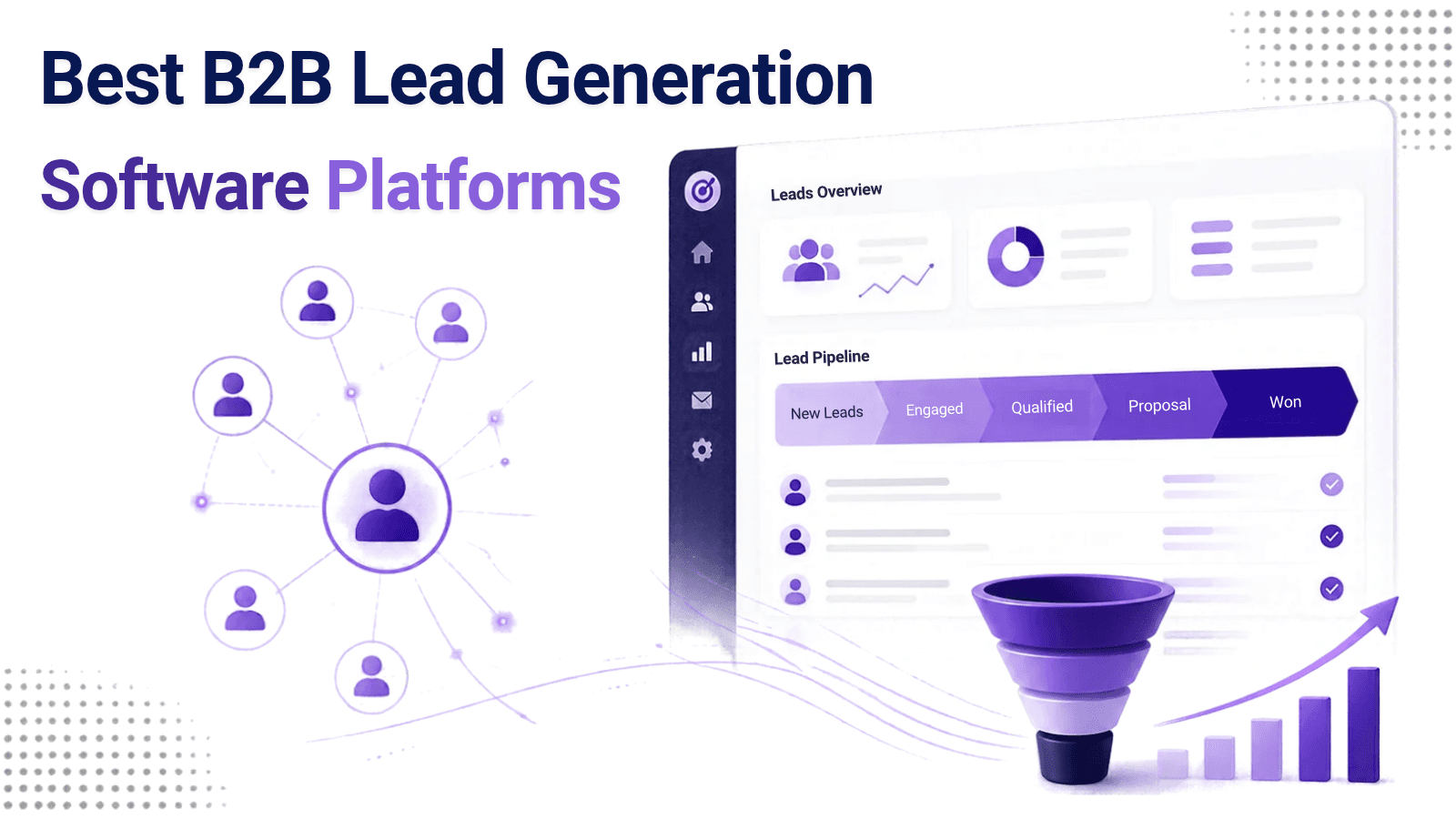
B2B lead generation has evolved beyond collecting business email addresses and building prospect lists. Modern sales teams need accurate contact information, detailed company intelligence, buying signals, and reliable data enrichment to identify potential customers and generate qualified sales opportunities.
As businesses expand into new markets and adopt increasingly data-driven go-to-market strategies, choosing the right B2B lead generation software has become an important part of building a predictable sales pipeline.
However, not every platform solves the same problem. Some specialize in contact discovery, others focus on sales engagement, buyer intent, account intelligence, or data enrichment. Understanding these differences is essential when evaluating software for your sales and marketing operations.
In this guide, we examine 10 B2B lead generation platforms, their core capabilities, ideal use cases, and the factors businesses should consider before selecting a solution.
What Is B2B Lead Generation Software?
B2B lead generation software helps organizations identify potential business customers, discover relevant decision-makers, collect professional contact information, and support the processes required to convert prospects into sales opportunities.
Unlike traditional lead collection methods, modern platforms combine multiple data capabilities to improve prospecting efficiency.
A comprehensive B2B lead generation solution typically includes:
- Contact Intelligence: Professional email addresses, direct phone numbers, job titles, seniority, and department information.
- Company Intelligence: Firmographic information such as industry, employee count, revenue, headquarters, and company growth.
- Technographic Data: Insights into the software, tools, and technologies used by potential customers.
- Buying Intent and Signals: Business events and research activity that indicate potential purchasing opportunities.
- Data Enrichment: Additional information to complete, validate, and update existing CRM records.
- CRM and Workflow Integration: Connecting prospect data with sales and marketing systems.
These capabilities help sales teams move from broad prospecting to more targeted account selection and personalized outreach.
Types of B2B Lead Generation Platforms
Before comparing individual solutions, it is important to understand the different categories of software available.
1. B2B Contact Database Platforms
Contact database platforms provide access to professional contact information and company profiles.
Sales development representatives use these platforms to find decision-makers based on job title, seniority, department, industry, company size, and geography.
They are particularly useful for outbound sales teams that need a consistent source of prospect information.
2. Sales Intelligence Platforms
Sales intelligence software provides additional context about target companies and their employees.
Beyond basic contact information, these platforms may include company growth, organizational changes, technology adoption, funding activity, and other business intelligence.
This information helps sales teams understand their target accounts and prioritize relevant opportunities.
3. Buyer Intent and Signal Platforms
Buyer intent platforms identify companies demonstrating potential interest in specific products or services.
Depending on the provider, these signals may include content consumption, website activity, technology adoption, hiring activity, funding announcements, and leadership changes.
These insights help sales teams identify potential opportunities and determine when an account may be worth approaching.
4. Data Enrichment Platforms
Data enrichment solutions improve the completeness and quality of existing business records.
They can append missing email addresses, phone numbers, company information, job titles, and technology details to CRM records or uploaded contact lists.
For organizations managing large databases, enrichment helps reduce manual research and improve data consistency.
5. Sales Engagement Platforms
Sales engagement software focuses on executing and managing prospect communication.
Common capabilities include email sequences, automated follow-ups, calling workflows, task management, and engagement analytics.
These tools typically work alongside contact databases and CRM platforms rather than replacing them.
10 Best B2B Lead Generation Software Platforms in 2026
The following platforms serve different requirements within the B2B prospecting ecosystem. They should be evaluated according to their capabilities and intended use cases rather than treated as interchangeable products.
1. BulkData.ai
Best for: Global B2B contact intelligence, prospecting, and data enrichment
BulkData.ai is a B2B data and GTM intelligence platform designed to help sales, marketing, and revenue operations teams discover business contacts, research target companies, and improve existing customer data.
The platform combines contact intelligence, company intelligence, email verification, technographic data, buyer intent, and CRM enrichment within a connected prospecting environment.
Its database includes more than 390 million B2B contact records across 195 countries, supporting organizations that need to identify potential customers across multiple geographic markets.
Key capabilities:
- Contact discovery using job title, seniority, industry, location, and company attributes.
- Company intelligence covering revenue, employee count, funding, hiring, and technology usage.
- Email verification before exporting prospect records.
- Direct-dial mobile number discovery.
- CRM enrichment for improving incomplete contact and company records.
- Technographic intelligence for identifying companies using specific technologies.
- Buying signals covering job changes, company events, leadership movements, and technology changes.
- API access and AI-assisted prospecting workflows through MCP.
Why consider BulkData.ai?
Many B2B teams need more than a contact database. They need a connected source of information that supports the complete prospecting process, from identifying target accounts to finding decision-makers and enriching existing records.
BulkData.ai brings these capabilities together, making it relevant for startups, growing businesses, and enterprise GTM teams looking to build data-driven outbound strategies.
2. ZoomInfo
Best for: Enterprise sales intelligence and account-based prospecting
ZoomInfo is an established B2B intelligence platform that provides contact information, company profiles, buying signals, and sales workflow capabilities.
Its platform is designed for organizations that require extensive business intelligence and integration with their existing revenue technology stack.
Key capabilities:
- B2B contact and company database.
- Direct phone numbers and professional email addresses.
- Firmographic and technographic information.
- Buyer intent and company activity signals.
- CRM enrichment and workflow integrations.
- Sales intelligence and account research.
Ideal use case: Mid-market and enterprise organizations with established sales operations that require comprehensive intelligence and account-based prospecting capabilities.
3. Apollo.io
Best for: Prospecting and sales engagement in one platform
Apollo.io combines a B2B contact database with sales engagement capabilities. It allows sales teams to discover prospects, build contact lists, and execute outbound campaigns within a single environment.
Its integrated approach is particularly useful for smaller sales teams that want to minimize the number of tools in their technology stack.
Key capabilities:
- Contact and company search.
- Advanced prospect filtering.
- Email sequencing and automation.
- Sales dialer capabilities.
- CRM integrations.
- Prospect research and enrichment.
Ideal use case: Startups, small sales teams, and growing businesses looking for prospecting and outreach functionality in one platform.
4. Cognism
Best for: European B2B contact data and phone-based prospecting
Cognism provides B2B contact and company intelligence, with a particular focus on European markets.
Its Diamond Data offering emphasizes phone-verified mobile numbers, making it relevant for sales teams that depend heavily on phone-based prospecting.
Key capabilities:
- Business contact database.
- Phone-verified mobile numbers.
- Company and contact search.
- Sales intelligence.
- Compliance-focused data processes.
- CRM and sales engagement integrations.
Ideal use case: Organizations targeting European businesses that require reliable contact discovery and phone-based sales prospecting.
5. LinkedIn Sales Navigator
Best for relationship-based prospect discovery
LinkedIn Sales Navigator helps sales professionals identify decision-makers and research companies using LinkedIn's professional network.
Its advanced search and recommendation capabilities make it useful for account research and relationship-led prospecting.
Key capabilities:
- Advanced lead and account search.
- Job title, industry, and company filters.
- Lead recommendations.
- Saved account and lead alerts.
- InMail messaging.
- Relationship and connection insights.
Important consideration: Sales Navigator is primarily a professional network discovery and engagement tool. Teams that need verified business email addresses and direct-dial numbers may require a separate B2B contact data provider.
Ideal use case: Sales professionals and account executives who rely on professional networking, relationship mapping, and warm introductions.
6. Lusha
Best for Quick contact discovery and individual prospect enrichment
Lusha provides access to B2B contact and company information through its searchable database and browser extension.
It is designed to help sales professionals find contact information while researching potential customers online.
Key capabilities:
- Business email and phone number discovery.
- Contact and company search.
- Browser extension for prospect research.
- CRM integrations.
- Contact list enrichment.
- Prospecting workflows.
Ideal use case: Individual sales representatives and smaller teams that need straightforward contact discovery and enrichment.
7. Seamless.AI
Best for On-demand contact discovery and outbound prospecting
Seamless.AI focuses on helping sales teams discover potential customers through its contact search and sales intelligence capabilities.
Its platform includes prospecting, contact research, and additional features designed to support outbound sales activities.
Key capabilities:
- Contact and company search.
- Email and phone number discovery.
- Prospecting browser extension.
- Buyer intent capabilities.
- Contact enrichment.
- CRM integrations.
Ideal use case: Sales teams that prioritize high-volume prospect discovery and want contact research integrated into their outbound workflows.
8. LeadIQ
Best for SDR prospecting and CRM contact capture
LeadIQ focuses on simplifying the process of identifying potential customers and transferring prospect information into sales systems.
Its workflow is particularly relevant for sales development teams that research prospects on LinkedIn and need to move contact records into their CRM or sales engagement platform.
Key capabilities:
- Contact capture from LinkedIn and web pages.
- Email and phone enrichment.
- CRM synchronization.
- Sales engagement integrations.
- Champion tracking and job change notifications.
Ideal use case: SDR and BDR teams that want to reduce manual contact entry and streamline prospect capture.
9. 6sense
Best for Account-based marketing and predictive buying intent
6sense focuses on identifying potential buyers through account intelligence, predictive analytics, and intent data.
It helps marketing and sales teams understand which accounts may be researching solutions and where to prioritize engagement.
Key capabilities:
- Predictive buying-stage identification.
- Account intelligence.
- Intent data.
- Account-based marketing.
- Audience segmentation.
- Campaign orchestration.
Ideal use case: Enterprise marketing and revenue teams running structured account-based marketing programs.
10. Clay
Best for Custom data enrichment and automated GTM workflows
Clay is a data enrichment and workflow automation platform that allows revenue operations teams to combine information from multiple data providers.
Rather than functioning only as a conventional contact database, Clay enables users to build customized prospecting and enrichment workflows.
Key capabilities:
- Multi-source data enrichment.
- Automated prospect research.
- Workflow automation.
- Custom data processing.
- AI-assisted research.
- Integration with external data providers.
Ideal use case: RevOps teams, growth engineers, and technically advanced sales teams that want to build customized prospecting workflows.
B2B Lead Generation Software Comparison
The following table summarizes the primary strengths and typical applications of these platforms.
| Platform | Primary strength | Best suited for |
|---|---|---|
| BulkData.ai | Global B2B intelligence and enrichment | Global GTM teams |
| ZoomInfo | Enterprise sales intelligence | Enterprise sales teams |
| Apollo.io | Prospecting and engagement | Startups and SMBs |
| Cognism | European contact intelligence | European sales teams |
| LinkedIn Sales Navigator | Professional network discovery | Relationship-led sales |
| Lusha | Contact discovery | Individual sellers and SMBs |
| Seamless.AI | Contact search | Outbound prospecting |
| LeadIQ | Contact capture and CRM workflows | SDR and BDR teams |
| 6sense | Predictive intent and ABM | Enterprise marketing |
| Clay | Multi-source enrichment automation | RevOps and GTM engineering |
Note: This is a capability-based comparison, not a universal performance ranking. Product features, pricing, database coverage, and availability may change. Evaluate each provider against your target market and operational requirements.
How to Evaluate B2B Lead Generation Software
Choosing a lead generation platform requires evaluating the quality of its data, the usefulness of its intelligence, and how effectively it fits into your existing sales process.
Here are six important factors to consider.
1. Contact Data Accuracy and Verification
Database size alone does not indicate data quality.
A platform may contain millions of contacts, but outdated job titles, invalid email addresses, and incorrect company associations can reduce the effectiveness of prospecting campaigns.
Evaluate providers based on:
- Email verification methodology.
- Contact update frequency.
- Job title and employment accuracy.
- Direct-dial availability.
- Duplicate record management.
- Data source transparency.
A useful evaluation method is to test a representative sample of records from your actual target market before purchasing a subscription.
2. Geographic Database Coverage
Global coverage is particularly important for businesses selling across multiple regions.
A platform that performs well in North America may have different coverage in the Middle East, Southeast Asia, or other emerging markets.
Before selecting a provider, examine the availability of contacts by country, industry, company size, and job function.
Do not rely exclusively on a provider's total database size. Ask for coverage information relevant to your actual target markets.
3. Advanced Prospecting Filters
Effective prospecting starts with a clearly defined Ideal Customer Profile (ICP).
Your software should allow you to segment companies and contacts using relevant criteria, including:
- Industry and sub-industry.
- Company employee count.
- Revenue range.
- Country and region.
- Job title and seniority.
- Department and decision-making role.
- Technology adoption.
- Funding and hiring activity.
The more accurately you can define your target audience, the less time your sales team spends researching irrelevant companies.
4. Buying Signals and Intent Intelligence
Contact information identifies who to approach. Buying signals provide additional context about why an account may be worth approaching now.
For example:
- A company increasing its hiring activity may be expanding its operations.
- A newly appointed VP of Sales may be reviewing existing sales technology.
- A funding announcement may indicate plans for business expansion.
- A company adopting a new CRM may present an opportunity for complementary solutions.
These events do not automatically confirm purchasing intent. However, when combined with firmographic and contact data, they can help sales teams prioritize accounts and develop more relevant outreach.
5. CRM Integration and Data Enrichment
A lead generation platform should complement your existing sales infrastructure.
Evaluate whether the software supports your CRM, whether records can be updated without creating duplicates, and whether enriched information can be synchronized efficiently.
For larger organizations, API access and automated enrichment workflows can significantly reduce manual data management.
6. Pricing, Credits, and Scalability
Pricing models differ across B2B data providers.
Some charge per user, while others use credits, data exports, enrichment volume, or custom enterprise agreements.
Before committing, understand:
- What actions consume credits.
- Whether unused credits expire.
- The cost of exporting contacts.
- Access to phone numbers and email addresses.
- Minimum seat requirements.
- Contract duration and renewal conditions.
- Additional costs for integrations or advanced features.
A lower subscription price does not necessarily mean a lower cost per usable prospect.
Why B2B Data Quality Directly Impacts Lead Generation Performance
Lead generation performance depends on more than the number of contacts entering your sales pipeline.
Consider a sales team targeting 5,000 decision-makers. If a significant portion of those records contains invalid email addresses, outdated job titles, or incorrect company information, the team may spend considerable time and resources contacting unsuitable prospects.
Poor-quality data can create several operational problems:
Lower email deliverability: Invalid addresses and repeated hard bounces can damage sender reputation.
Inefficient sales activity: Representatives spend time researching and correcting incomplete records instead of engaging with potential customers.
Weak segmentation: Incorrect industry, company size, or job information can lead to poorly targeted campaigns.
CRM inaccuracies: Outdated records affect reporting, account ownership, and sales forecasting.
Missed opportunities: Missing contacts and incomplete company profiles can prevent teams from identifying the right decision-makers.
This is why businesses should evaluate lead generation platforms based on the usability and reliability of their data, not just database size.
How BulkData.ai Supports Modern B2B Prospecting
For sales and marketing teams operating across multiple markets, access to reliable business intelligence is essential.
BulkData.ai brings contact discovery, company intelligence, email verification, data enrichment, technographic information, and buying signals into a connected B2B intelligence platform.
Its capabilities support three important stages of the prospecting process.
1. Discover the right companies and decision-makers
Sales teams can define their ICP using company and contact attributes, including industry, location, employee count, job title, seniority, and technology usage.
This makes it easier to create targeted prospect lists based on specific business requirements.
2. Add relevant business context
Company profiles, technographic information, and buying signals provide additional context for evaluating potential accounts.
Rather than relying exclusively on static contact records, teams can consider company developments, leadership changes, hiring activity, and technology adoption when prioritizing prospects.
3. Enrich and activate existing data
BulkData.ai supports CRM enrichment, email verification, and API-based workflows to help organizations improve their existing records and incorporate business intelligence into their sales operations.
The platform also offers MCP capabilities, allowing compatible AI assistants to interact with B2B intelligence through natural-language workflows.
With more than 390 million contact records across 195 countries, BulkData.ai is designed to support organizations that need scalable prospecting and business intelligence beyond a single geographic market.
Final Thoughts
The best B2B lead generation software is not necessarily the platform with the largest database or the greatest number of features. It is the solution that provides relevant, reliable data and supports the way your sales organization identifies and engages potential customers.
For some businesses, this means prioritizing sales engagement and automation. Others may require advanced account intelligence, predictive intent, or customized enrichment workflows.
Organizations targeting multiple markets should also pay close attention to geographic coverage, contact verification, and the availability of relevant company intelligence.
As B2B prospecting becomes increasingly data-driven, investing in the right intelligence infrastructure can help sales teams reduce manual research, improve targeting, and build more effective pipelines.
BulkData.ai brings together global B2B contact intelligence, company data, buying signals, and enrichment capabilities to help businesses make better-informed prospecting decisions.
Explore BulkData.ai to see how a connected B2B data platform can support your next stage of growth.