
How to Measure B2B Contact Database Accuracy Before Running an Outbound Campaign: A B2B Data Provider Checklist
Any B2B data provider will describe its data as accurate, but the number only means something when you measure it against your own target segment.
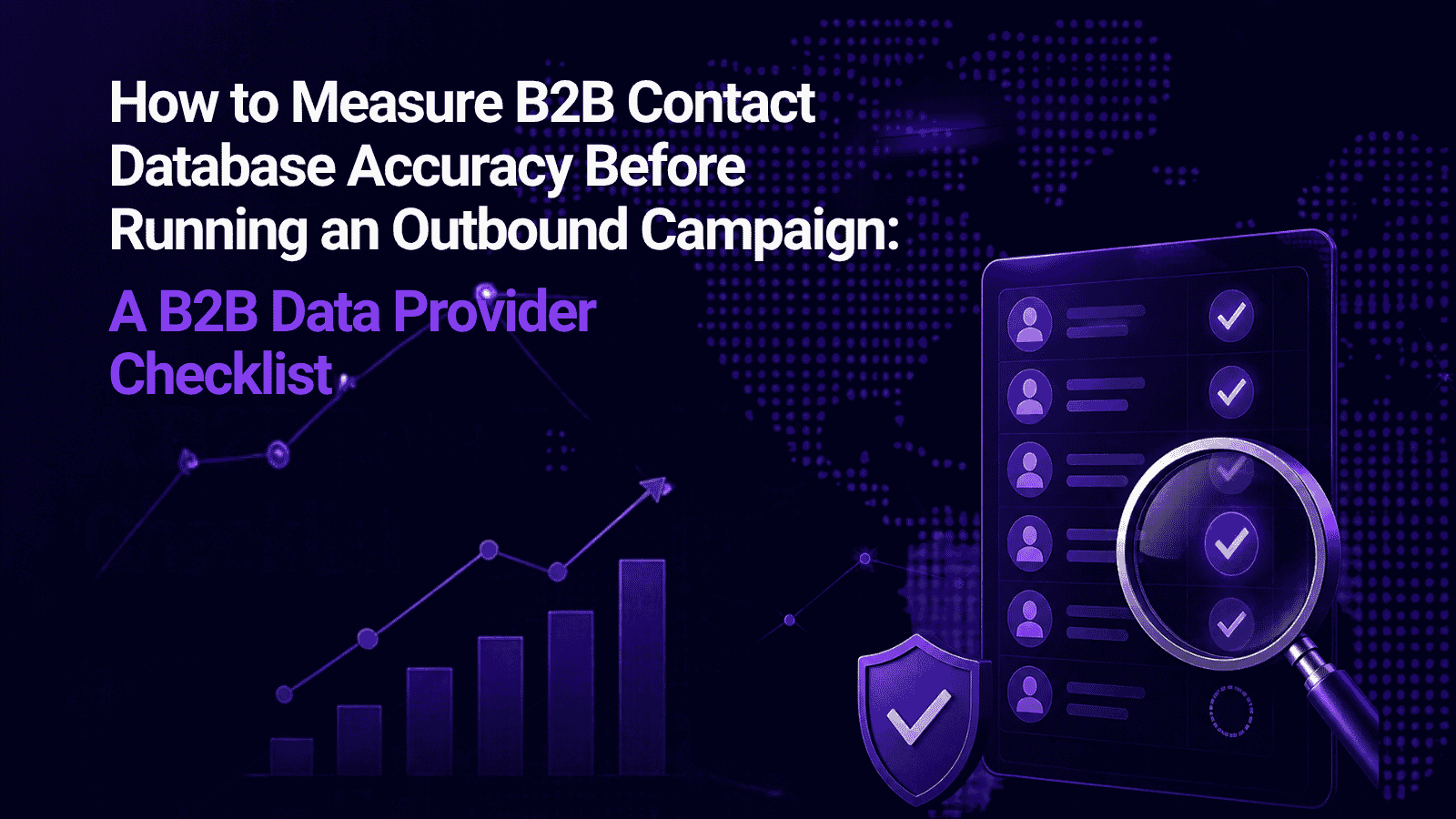
To measure B2B contact database accuracy, pull a random sample of 300 to 400 records, verify each field independently, and calculate field-level accuracy rates for email validity, job title, employer, and phone connectivity. Then confirm the results with a small seed send before you commit the full list. Any B2B data provider will describe its data as accurate, but the number only means something when you measure it against your own target segment.
What “Accuracy” Means in a Contact Database
Accuracy is not one metric. A record can have a deliverable email and an outdated job title, and it can pass verification yet belong to someone who left the company. Measure these fields separately:
- Email validity: whether the address exists and accepts mail.
- Role accuracy: whether the person still holds the listed title and works at the listed company.
- Phone connectivity: whether the number reaches the person (direct dial or mobile) or only a switchboard.
- Firmographic match: whether industry, headcount, and location match the company’s actual profile.
- Duplicate rate: how many records repeat the same person or account.
Also check the “last verified” date. Records without one are harder to trust, because B2B data decays as people change jobs and companies restructure.
How to Audit a B2B Data Provider’s Sample
- Sample from your ICP, not from the provider’s showcase. Request a random, stratified sample across your target industries, company sizes, and titles. A provider’s overall average can hide weak coverage in your segment.
- Size the sample deliberately. At 95% confidence, 300 records gives a margin of error of about ±5.6 percentage points, and 400 gives about ±4.9. Smaller samples produce numbers too noisy to compare across vendors.
- Verify emails with an independent verifier. Do not rely on the provider’s own verification flag. Record valid, invalid, risky, and catch-all results separately, because catch-all domains accept all mail and cannot be confirmed at the mailbox level.
- Manually check roles. Check 50 to 100 records against the LinkedIn profile and the company website for current employer and title.
- Test phone numbers. Call a subset and log whether each reaches the person, a receptionist, a voicemail box, or a dead line.
- Score each field and compare. Run the same audit on every B2B data platform you evaluate so the results are comparable.
Confirm With a Seed Send Before Scaling
Spreadsheet audits do not show how mailbox providers will treat your sending domain. Send to a small batch first, using a domain and mailbox configured with SPF, DKIM, and DMARC. Track hard bounces, soft bounces, replies, and “no longer at this company” responses.
Hard bounce thresholds vary by email platform, and many teams treat roughly 2% as a ceiling, so check your own provider’s policy. Gmail and Yahoo’s bulk sender requirements also expect spam complaint rates to stay below 0.3%, and recommend staying under 0.1%. A high bounce rate or complaint rate in a seed send is a signal to clean the list before scaling.
Where Bulkdata.ai Fits
Bulkdata.ai is a B2B data platform for building contact lists from ICP filters. The most useful way to evaluate it, or any alternative, is to request a sample matched to your filters and run the audit above before you buy volume. Judge providers by their field-level accuracy rates on your sample rather than by headline database size.
Contact database accuracy is measurable before launch. Sample 300 or more records from your own ICP, verify email, role, and phone fields separately, and confirm the results with a controlled seed send. Choosing a B2B data provider on audited accuracy protects your sender reputation and keeps reps working verified contacts.